Wednesday, October 20, 2021

Retrieval Practice in Practice


NEA's September issue contained an article titled, "The Science of Learning," which shared some practical instructional tips classroom teachers could learn from psychology teachers based on what we know about how students' brains work. The article as a whole offers several interesting ideas and it's a quick read (full article linked here), but one idea in particular stood out to me--retrieval practice.

For the last few years, I have been thinking about retrieval practice and its potential benefits in learning.  Basically, the act of struggling in short, frequent bursts (practicing) to recall (retrieving) information that you've previously learned actually helps that information become more solidified in your brain.  UDL being the lens through which I view just about everything, when I first started learning about retrieval practice I created the image below to help myself visualize what is happening in learners' brains when they're putting in and pulling out information they are trying to learn. 
                                                   
My image is likely an oversimplification of the process, but at the very least, it helps remember that when we're asking students to express and act on what they've learned, that info lives in the back of their brain and they have to "reach in" and "pull" it out. Like a neglected forest path, thick with overgrowth, the unused pathways in our brains become overgrown and it takes longer to travel through to get to the information. Retrieval practice is the intentional act of "traveling" that path in our brains to wear down the overgrowth and helps us access the information quicker and with greater durability. Think of it as actively working toward "Use it" to avoid the "lose it" scenario.

There are a few key points about retrieval practice  I feel we should consider before implementing with our students.
  • FORMATIVE: Retrieval Practice is PRACTICE for learning and not an Assessment of learning. Retrieval practice activities should be low stakes and ungraded. Attaching a grade, quiz, or assessment to retrieval activities removes the practice element and adds a possibly punitive element to what should be a low-risk practice. Frequent practice helps students feel more comfortable and confident with their own ability to learn, which is what helps students feel successful and see themselves as capable.
  • STRUGGLE: Struggle is an intentional and essential component of retrieval practice--working hard to recall information has been shown to increase the likelihood that you will remember it in the future. With struggle, though, it's important to consider how long to allot for retrieval practice activities so that students aren't struggling for 20+ minutes with what feels like no end in sight. Alternatively, allotting way too little time could cause students to shut down and send the message that the activity is about speed and not recalling information.
  • NO REFERENCE MATERIAL: While we want our students to be resourceful learners who access references and resources when needed,  the purpose of retrieval practice is to strengthen the pathways to information in our own brain so we don't have to rely on those references all the time. Since there is no assessment tied to this, retrieval practice activities should be designed so students don't feel the pressure to pull out materials and copy answers.

 Retrieval Practice in the Classroom

1. Retrieval Grid-( idea from NEA article) Similar to a bingo cards, there are a variety of questions for students to answer, with lower point items being materials they've just learned and highest point value being material from longer ago (reinforcing the practicing of pulling out old info to build stronger neural pathways to that info). With practice, over time students should notice they can pull more info and faster.  I made sample one for ELA that could be created for any content area. The point values and timeline for when you pull information from can vary as well.  
Implementation Tips: Give students a short amount of time to complete as many questions on the grid as they can before revealing answers. Students count up the number of correct answers and add points. You could use the grid with similar content ("testing" same info) later in the week and have students count points on a second attempt. These points are purely for the students' own self-reflection about how much of the content they've mastered. I could also see a group work element to this after some independent time with the grid. 

Sample grid HERE

2. Flashcards (as group activity): While flashcards are not revolutionary, especially for people who have learned how to learn/study, the intentional practice of recalling information through flashcards is a useful tool. Designing lessons so that all students get the support and push they need is challenging and especially in rooms with a single teacher, it can be difficult to find small group time with students who need more support. Retrieval Practice tells us that all learners can benefit from actively recalling previously learned content and flashcard stations could be a way to meet both teacher and student goals. (Note-Quizlet and other online flashcard-esque tools are great as well, but there is also benefit to slowing down this process and ensuring that students are truly retrieving information before moving onto the next card). 

Implementation Tips: Create a couple different decks of flashcards with a range of content learned at different periods of time--there could even be a couple terms/concepts from the previous year's content. For students who have shown competency in the current content goals, maybe they have a deck with more cards of older information to increase the challenge. If your intention is to build in face time with students who need an extension, maybe there is a deck for students who haven't yet mastered the material with a greater number of recently learned information to build confidence and success. In either case, students will need explicit directions around "quizzing" each other using cards. 
For example: display only one side of the flashcard to the person being quizzed. Try not to rush or settle for partial answers--let the person being quizzed talk out the full answer and see how close they get. Leave all cards in the deck--even the ones the ones you get correct easily--repeated exposure to the information helps cement the learning. Shuffle the deck so the cards aren't asked in the same order every time.

Both of the examples above require a bit of planning on the teachers part and might also take a little more time than other possible retrieval practice opportunities.  A more "on the stop"  retrieval practice example could be a Do Now or Exit Ticket activity. Give students a topic (recent or near distant) and ask them to write down everything they remember about the topic. This could lead to pair n' share comparisons, small group talk or even a whole class chalkboard splash.  While working with  some 6th graders on Greek & Latin roots, I incorporated quick retrieval practices by asking students to list as many of the roots we had studied and their definitions as they could recall.  They checked their accuracy and total count against the answers I displayed, and we did that a couple times throughout the week--each time taking under 5 minutes total.  Activities like these could be done relatively quickly and give students chances to pull that info to front of mind. 

In their book make it stick,  the authors make the point that teachers may be the ones initially directing and introducing the retrieval practice, but that at some point that can and should shift to students doing this for themselves. When we offer these structured opportunities for our students with our content, we also provide them with explicit study skills that help them become more intentional learners. 


Resources for reading more retrieval practice:  

  • Retrieval Practice website: https://www.retrievalpractice.org/why-it-works
  • make it stick: The Science of Successful Learning (Brown, Roediger III, McDaniel)
  • "The Science of Learning" https://www.nea.org/advocating-for-change/new-from-nea/science-learning


Monday, October 19, 2020

Look Micro-routine Recap

In the ELA Department's most recent PLG we examined a couple Micro-routines for Literacy put out by New Vision for Public Schools.  One appealing feature of these routines, which have been adapted specifically for remote instruction, is that they are intended to take a short amount of time and have very few steps. As I've been sharing micro-routines with teachers in and out of the ELA department, I sense a healthy amount of skepticism from teachers about the actual amount of time these routines would take. While it is within our control and discretion to adjust the timing to suit our students, I also see the value in keeping to these time frames. 

For one, we know that everything (everything!) seems to take longer in the remote classroom. I wonder if sticking to the brief time limits of these micro-routines could actually be a way to increase efficiency. If we incorporate the routine frequently enough,  students' ability to respond within the time frames may increase. 

Another benefit to sticking closely to the allotted time is that even if things feel like they're going poorly, the routine only lasts for 6-ish minutes. When we think about the UDL concept of varying demands and resources, one really interesting way to create a reasonable challenge for students is to play with time. If they run out of details to share or feel confused about the image you're using in this routine, they know each step of the routine will only last for two minutes and they won't be struggling for an undetermined length of time.

WHY  include the Look routine? 

  • To provide multiple representations of ideas and concepts students are studying
    • when using images/art specifically, to provide an alternative to print text.
  • To provide opportunities for students to observe closely and identify specific details
  • To pique students' curiosity about something they will read more about or extended their thinking about a topic they've already read about.
  • To increase students' comfort and confidence in speaking out loud and sharing with the class
    • Naming specific details students have observed seems like a low-risk, high reward opportunity for student participation

HOW I might implement Look:
(Ideas that follow assume that the routine has been introduced and practiced with familiar content and students are familiar with the routine).

  • Choose an interesting image that connects in some way to a thematic idea of a text students will be reading in ELA class.
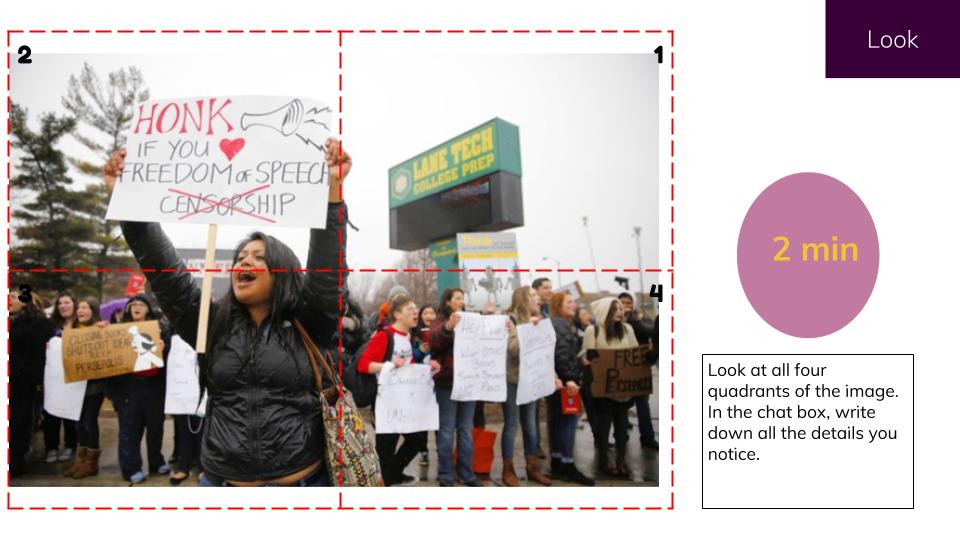
  • Display the image for students and allow them 2 minutes to look closely at the image and use the CHAT  to record as many details as they notice in the quadrants. Give students 2 minutes to share out loud the details they find to the most interesting in the quadrants (as outlined in the slides example we looked at). 
  • Repeat the Look process with a second related image. There are a few possible approaches I can imagine for this.
    • If your students are efficient with breakout rooms this could be a way for students to engage in the Look routine in a much smaller group.  When students return to the whole group (after 4 min), each group could share out the most interesting details they discussed.
    • We discussed the possibility of assigning students different quadrants to focus on and share out with the class. This could be done by displaying a list of student names in a grid on the slide (pictured below). Assigning students to specific quadrants could help limit the amount of students entering in the chat at once in the first part of the routine.
  • Pair these images with a short excerpt from the anchor text students are reading. After students have examined and discussed ideas in one or two images, provide them with a short reading excerpt that examines some of the ideas reflected in the images. Students could complete the reading semi-synchronously annotating for a specific reading focus. For example, after examining the two images about "courage" students could read an excerpt from Number the Stars. A possible reading focus could be to identify evidence in the excerpt that reveals a character's courage. (RL 6.1 citing evidence and RL 3 character's reaction). Students could complete a reading in pairs, small groups, or independently depending on how the teacher wanted to structure this.
  • Return whole group and have students share examples of the textual evidence they cited. Examples could be shared by cold-calling on several students, asking students to agree, disagree, or add-on to a peer's response. Students could type evidence in the chat, but if they've also completed a Google Doc with annotations, sharing in the chat may not be worth the time.
  • Possible Exit Tickets: Use a Google Form and ask students to share an interesting observation they heard a classmate share today. Ask students to explain which of the two images they think best pairs with the excerpt they read. Students will have to pull evidence from both texts in order to explain thoroughly (RL 6.1).

Below are some examples that I compiled should anyone want to incorporate this routine into an upcoming lesson. Each of the images align with a thematic idea explored in each of the Trimester 1 Anchor Texts for grades 6-8. 

Grade 6 Examples for the thematic idea of courage. Number the Stars


Grade 7 Examples for the thematic idea of empathy. Walk Two Moons

Grade 8 Examples for the thematic idea of censorship. Fahrenheit 451


One of the groups also discussed the idea of concealing some of the quadrants in the beginning of the routine and to slowly reveal each quadrant so the students could see the image being pieced together. This was an easy adjustment to the slide by simply adding filled-in shapes and covering up the quadrants 2-4. The video below shows an example of the "slow reveal" version of Look. 

For anyone interested in using the images they slides template is linked here. Please share additional ideas or experiences with the Look Micro-routine!


Tuesday, October 13, 2020

padlet for Recording Student Reading

One of the strangest parts of teaching remotely is not hearing the noise of student talk in classrooms, or sometimes students' voices at all. When meeting with the 6th grade ELA teachers from across the district last week, several of them brought up the concern of not being able to hear students read out loud very often. This was something I'd actually been thinking about over the summer when I was considering the many different ways in which we could use padlet for remote instruction.

padlet is a versatile tool because it allows students to express their understanding and learning in multiple ways. Students can type, draw, film or record themselves, and more.  Many students prefer to keep their cameras off, for a variety of legitimate reasons, but the film recording is one option for students who don't mind showing their faces but need to find the right time and place to have a distraction-free environment. The audio recording feature has good appeal as a way to keep in touch with what students are reading and to hear how they are reading.

I envisioned  just a few possible ways this could be organized, but of course there are many more possibilities. 

1. Teacher-created: Create a padlet using the "Grid" or "Wall" format for the page. Ask students to create a post in which they include their name, the title of the book they're reading, and a page number. Student can then click the three dots icon to produce the dropdown and select the purple "Voice" icon.  This allows students to record themselves for up to 15 minutes. Although they shouldn't need that much time it's nice to know a slower reader won't be cut off before finishing their page. I created an example padlet like this and set it so that I could both add a comment and give a "grade" is this was something I were scoring or tracking. Even if I were not going to give a score to these recordings, I'd still keep the comment feature open so I could provide feedback. Here is a link to the example padlet with an example student post. One drawback to having all students post to this same padlet is that they would all be able to hear each other's recordings. While it might be nice for students to see the books their peers are reading, I can also see why this might not be desirable so I started brainstorming other ways I might organize this. 

2. Teacher-created & Organized: Create a padlet using the "Shelf" format for the page, which will allow you to have student recordings organized in whatever system makes sense for you. In the example, I created columns by month because I thought it would be a nice way for students to collect their progress across the year. The brief video below shows how to set up this padlet, with comments, grading and the Require Approval Setting. By requiring post approval, none of the students' post will be visible on the public padlet until you listen and give your approval. This is a way to to limit students listening to each other's posts if you are concerned about that. 

After all students have submitted a post, you could also go in and create a password for the padlet so that students cannot go back and look at the padlet until or if you give them the password.

3. Student-created: If you wanted students to create their own padlets to recording their reading there are a couple of easy steps. First, students need to create their own padlet accounts. This is free and easy to do by visiting this link. Second, you would could show students how to create their own padlet OR you can set up a template for how you want it organized and ask them to create a REMAKE of the template. By copying the format and the posts, students will have a ready-made padlet for them to begin recording their reading. The video below shows how to create Remake of an existing padlet. Note, students must have their own padlet account in order to create a Remake.


Reading out loud to our students whether during live lessons or in pre-recorded videos during independent work is a great way to continue exposing students to model fluent readers. It's also important for us to hear how students are progressing in their reading especially since they may not have as many opportunities to practice reading while at home. padlet is just one tool that we can use to record and collect our student reading, as well as provide feedback. I'd love to hear how teachers are using this and other tools to stay connected to students' reading!


Monday, October 12, 2020

Exploring Close Reading Routines for Remote Learning

Planning for a once a week 60 minute PLG that is sandwiched in between four back-to-back teaching periods and a staff meeting on Friday afternoon sure does have my brain working overtime! My son has many times explained the sweet spot of the bat to me, and I think that's what I'm seeking with PLG. In order for PLG to feel like a "homerun" for all, it's important to find that balance of sharing resources and ideas without risking cognitive overload and shut down. As with our students, the truly difficult part of this is that everyone's threshold for shutting down varies! Overall, though, the majority of the group appreciated time to share successes and struggles with each other and also to explore a resource of their choice. 

Despite having to adjust our practice and potentially let go of many of the activities and materials we would use in a typical school year, close reading is a practice that will always be an important one for students. It was really nice to see the energy and enthusiasm of the discussion around close reading and the possible ways these strategies could be used with our students. 


The Annotation Routine for Remote Learning offered a framework that could be used repeatedly with different texts, for different purposes and in a variety of ways. In the example video, the teacher had a small number of students working in the same document and gave them a specific focus for their reading and annotation.  I appreciated the way she had her Google Doc set up with the Annotation Focus grid set in the Header and in the Footer she had sentence starters for how students might respond to their classmate's comments. 

I had shared this annotation routine with an 8th grade ELA teacher earlier in the week and she used it with a small excerpt of Fahrenheit 451. Logistically, there were a couple of things to consider when setting this up.
  1. To avoid the overwhelming and possibly distracting scenarios of 25+ students all highlighting and commenting in the same document,  she used breakout rooms and had those smaller groups use a single shared document for annotation. 
  2.  She had to group the students as well as create and post links to each of the breakout rooms in the slides.
  3.  For the close reading document itself, she had to create multiple copies of the same document and only assign it to specific students (according to how she had grouped them). This was one of those "little details" that could have been the difference between confusion and wasting time or having the class run smoothly! 
I was fortunate enough to join some of the breakout rooms and listen in as the students discussed the small excerpt of text. Students used the Annotation Guide at the top of the document to direct their conversation, especially when they were trying to decide what to highlight and comment about. The number of students in each group (4-5 max) was a really nice amount of students to allow for multiple voices as well as for a controlled number of readers highlighting and commenting in the document. 
                                                
 Annotation Routine, student example
Routine from New Visions for Public Schools

While certain groups needed more support than others, each group I visited was grappling with the text to some degree. Some students felt more comfortable highlighting the text only so I would either type in Chat or ask out loud if they highlighted that because the language grabbed their attention or because it revealed something about Montag (the annotation focus questions). Each time, the student was able to provide a reason for their highlighting. As a support, I inserted a comment, transcribed their explanation and attributed their name. I then encouraged them to go back and comment on other areas they had highlighted. 

This worked really well with the small group sizes created by the teacher. Also, she was asking them to annotate with a character and language focus that they had previously done together with a different excerpt from the novel. Apply a familiar annotation focus to a new piece of text allowed the students to draw on prior experiences with close reading.  I could also see using this format for a formative assessment with a new piece of text and produce a short written response. Alternatively, I could imagine assigning partners and having students first independently annotate their own document. After independent annotation, students could swap documents and respond to each other's annotations using comments. 

Three Reads Protocol from New Visions for Public Schools was another close reading approach that some of us explored in PLG. This was protocol was not specifically adapted for remote learning,  but I could easily see using this remotely in both a live lesson or as independent work. 

The purpose of the protocol is basically to have students focus in on a much smaller excerpt of a larger text and to read it at least three times, each for a different purpose. The explanation and examples of the Three Reads Protocol provide several different ways you might tweak the purposes for which students read. While you might have students read to Comprehend, Analyze, and Connect, you could change these purposes and have students read to focus on Vocabulary, the Main Idea, and Comprehension. The reading focuses you have for students can change depending on the goal, the complexity of the text, and the amount of scaffolding needed. 

I used the same excerpt from Fahrenheit 451 in the example below to show how I might use this protocol. This could be done in small groups with students working from the same document, highlighting and adding text to the blank boxes. The Three Reads Protocol could also be done independently, with students bring their notes to small group or whole group conversations. 

Example of Three Reads Protocol using Fahrenheit

As with any new routine, I'd model the Three Reads Protocol whole group so students could hear the thought process and see how to annotate.  The first time I asked students to use this protocol, independently or in small groups, I would probably choose a piece of text we'd already read once and ask them to read for purposes we'd previously done together in class. 

I look forward to seeing how these, and other close reading routines, get  incorporated into remote ELA classrooms! 


Sunday, October 4, 2020

Debriefing Hexagonal Thinking Discussion Strategy

In our most recent PLG time, our ELA department engaged in a discussion strategy in small groups through Google Meet. Hexagonal Thinking is a discussion strategy from Spark Creativity's Betsy Potash that I first came across after talking with a friend and colleague who had listened to the Cult of Pedagogy podcast. 


While there are many practices we'll have to reexamine to see if they still have place and purpose in our remote classrooms, giving students opportunities to engage in open-ended tasks that encourage critical thinking and discussion is something we should continue to prioritize. 


Here is a recap of some points from our Hexagonal Thinking Discussion debrief.
  • This seems like a good strategy for visual/spatial learners
  • It would be beneficial to build  in some independent think time before discussing in groups.
  • Groups may need some direction about how to decided how/who will move the terms. decide  Will one person be responsible for all the dragging or will everyone pitch in? I thought about this afterward, but I remember Potash discussing in the podcast that it interesting to see which natural roles students might fall into in this kind of work. I do actually like her point of valuing all types of contributions, but I can also see that especially in this new and strange remote classroom, assigning roles may be a helpful way to avoid additional awkward encounters. 
  • The first choice felt the hardest and like such an important one. Maybe explicitly calling this out for students would be helpful.
    • Perhaps pointing out parts of speech of words and let students start grouping in that way would help students  get started.
  • This activity could be done in a few ways.
    • As independent (asynchronous) pre-work (preview terms and make a few connections to bring to class). In live lesson group students into breakout rooms for placement & explanation & then share out whole group.
    • Semi-sync: Explain, provide think time (semi-sync) and then move into breakout rooms. Come back and share out
  • Other scaffolds/considerations:
    • Start with fewer terms and fewer hexagons
    • Include images and words in hexagons
    • Ask groups to place terms and then ADD __ (number) of terms themselves
    • Ask students to generate the list of terms related to recent study. Use their​ list for the hexagon webs. 
One thing I didn't do in PLG was explicitly model, through Think Aloud, how I might connect a couple of terms and why. I excluded that in the interest of time with adult learners, but would most certainly begin with that modeling, as well as short burst of time in small groups. 

Here are the hexagon webs and connection explanation from our work. 


Hexagonal Thinking is a strategy that has great appeal across disciplines. In fact, my colleague who turned me onto the podcast teaches science and was excited to think how this could be used with her content. It's worth noting the cross-content value of this strategy, especially in a time when we are trying to use familiar strategies and with routines in order to minimize confusion and maximize clarity and learning.

For those interested in obtaining their own copy of the Hexagonal Thinking templates, visit Spark Creativity here and request a copy for your own use.  This resource includes templates where students can move hexagons and ones where they can move the terms.


Looking forward to how some of you may incorporate this, or variations of this, strategy into your classrooms with students!

Thursday, September 12, 2019

Ready to Listen

A few years ago I was challenged by a fellow coach to write about my experience as a teacher. In response to the seemingly constant stream of negativity surrounding public education, she had a vision to create a collection of narratives from teachers to show those outside the classroom what teaching is really about. I was fortunate enough to have a group of 8th grade students read my piece and give me incredibly thoughtful feedback to help me improve it greatly.

Over the first few weeks of school I've been engaging in so many rich conversations with teachers about instruction and building relationships with students, I'm reminded of how important writing can be in the relationship-building process. As I enter my 16th year of teaching, I think back to the lessons I learned in my first months of teaching.


Ready to Listen


My 4th grade teacher, Mrs. Dianne McLaughlin, was a middle-aged woman with short sun-colored hair and tanned skin that I’m sure spent many days glistening on the beaches of the South Shore. We began each morning with finger warm-ups to get ready for work, followed by morning greetings in at least three languages other than English. Guten Morgen, wie geht es dir is still the only German I know. Our vocabulary journals were filled with “adult” words I was so proud to be learning--debris, superior, reluctant, impermeable. We memorized and recited poems, “Once upon a midnight dreary, while I pondered weak and weary,” enjoyed intriguing read alouds, and wrote our own stories to which Mrs. McLaughlin responded with enthusiasm. When I threw away my retainer on ham and cheese day in the cafe, she turned a disaster into a class dumpster diving expedition. She set high expectations and demanded we reach them. She instilled in me of a love and language and learning. She nurtured without ever patronizing us. Before 4th grade, I had ideas of becoming a hairdresser or maybe a journalist, but after my year with Mrs. McLaughlin I knew for certain the only thing I wanted to be was a teacher who might make one student feel as important and valued as she made me feel.   


A decade after leaving Mrs. McLaughlin’s class, having taken a less than linear path, I was holding  a preliminary teaching license. I waited tables and interviewed at any school that would take a chance on an English major with no education coursework or teaching experience. Finally, in mid-February 2005, I landed the interview that earned me a position as a middle school English Language Arts and Reading teacher. One week I was a full-time waitress and the next I had my own classroom full of students, yet I had little idea what to do in my new role. I met with my patient Humanities Director at the time to ask my burning questions--How do I know what to teach? How long do I spend on each book? What do I say when a student gives a wrong answer? I was all detail and no big picture. She gave me some much needed advice about establishing rules and what to expect from these students who’d had no consistent teacher for months. Before my first day I bought the clothes and teacher shoes to make feel a little more like Mrs. McLaughlin and a little less like the petrified twenty-two year old I was.


Those first few months in the classroom felt like performing on the big stage without of any the rehearsal. Never before had I doubted my own ability to spell common words the way I did once I picked up that yellow chalk from a dusty chalk tray and began to write on the board in front of room full of students. To quell my fears I would chant to myself, They’re not laughing at me. They’re not laughing at me. I think. These students, my first students, seemed older than I remember looking in 7th grader and they were bold. The truth of what happened with their first teacher be damned, they wanted me to know it was they who had forced her out. They loved to talk loudly in homeroom about the many ways they had embarrassed or tortured her. Most stories ended a few weeks into my time with them after I joined the conversation and said with all the feigned confidence I could wrangle, “You should know I don’t scare that easily, I really need this job and I’m definitely not leaving.” 


I listened with deference to my veteran colleagues who cautioned me against idle hands by planning “lessons” that I was sure would fill the entire class period. My skill set as a teacher was far too limited at the time to think about student engagement, cooperative learning structures, or crafting lessons with clear goals and materials that allowed all students to access the learning.  Admittedly, my driving question during planning was, Will this take up enough time?  Reading comprehension questions--lots of them--were a sure-fire way to achieve this goal. On the days I stayed at school grading papers well into dinner time or when a student caught me looking longingly at the clock, willing the period to end, I wondered how I’d ever become like Mrs. McLaughlin, especially with students who seem so disinterested in learning from me.


I learned fairly quickly that I would probably have to adjust my grand plans of analyzing and discussing classic literature. My students stumbled over multisyllabic words during oral reading, struggled mightily with the vocabulary in our texts and produced writing of simple sentences rife with errors.  Part of this judgement came from my disillusioned account of the kind of work I had been capable of as a 7th grader.  Another part, as I came to find out, came from my total ignorance of my students’ life experiences. 


Just as all my cherished memories of Mrs. McLaughlin’s class have remained vivid, one particularly painful memory from the first few months of teaching has lingered in mind during long, quiet commutes to school, or any time I’m thinking about a student I haven’t connected with yet.  Part of my teaching assignments was to teach the honors reading class. The honors students obediently read the stories and answered the basic comprehension question with efficiency. We ploughed through our Junior Great Books stories and corrected the reading check questions with little enthusiasm. Soon, I realized, I’d need to find more work to fill each class period so I began adding a few open-ended questions to their worksheets that required more writing. 


We read Ivan Turgenev’s story, in which an old man reflects on his younger life and tells the story of himself as a young boy in Russia. As an adolescent, his desperation for his cousin’s acceptance caused him to discard, and later steal back, a treasured watch given to him by his godfather. This one event had a domino effect for the boy and became an event he continued to retell into old age. For my compliant and efficient honors students, I added this open-ended reading response question: 

Alexey was just a few years older than you are now when the watch incident happened but it stayed with him far into adulthood.  Write about a memorable event in your life so far that you think you will still remember when you are an old man/woman. 


When I assigned the question I likely assumed my students, with their barely thirteen years life experience, wouldn’t have much to write about, but I figured it would fill the time. The next day my class returned with their work mostly complete and I offered them the chance to share what they’d written about. I’m sure a few students obliged and shared their work, but I remember only one.
Julia, a tall Mexican girl with brown hair in perfect waves cheerily raised her hand.  For the few months I’d known her, I had rarely seen her without a wide, dimpled smile that shone out through her eyes.  She was one of the first students to make me feel welcomed in my own classroom, even going so far as to tell me I should probably ignore some of the horror stories I was hearing from my other students. In the classroom, halls, and lunchroom, Julia was surrounded by a group of friends who were often giggling loudly.  Paper in hand, Julia walked to the front of the room and I scooted into her seat.


Before she began reading, Julia inhaled and pushed an anxious breath through her lips.  


“My father left Mexico and came to the United States when I was nine.” Julia began. “But I didn’t come here until I was ten. I stayed in Mexico with my mother and brother until my dad was ready for us.  He sent my mom money to help us, but I missed him. One time…” 


Julia paused and stared down at her paper.  Until this point her voice had been strong and steady. 
“One time…” she tried again.  This time her voice held none of its usual confident buoyancy. Julia covered her face with one hand and the paper in her other hand shook back and forth as she sobbed, its quiet flickering the only other sound in the room.  


Here it was, my moment to make a student feel valued and loved like Mrs. McLaughlin surely would have. I froze. I moved not one inch in the chair and stared at my student in obvious pain.  Full of self-doubt, I wondered fearfully, Am I allowed to hug students? Do teachers comfort student like that? How serious is this story? Should I say it’s okay and tell her to sit down? 


It felt like an uncomfortably long time until the scraping of chairs on tile broke the quiet. Two of Julia’s classmates rushed to the front of the room and embraced her. As she continued crying, they wiped her tears, took her paper, and clutched her hands. And then, beautifully, they read Julia’s story of family finally reuniting in the United States after years of separation and sacrifice. The class listened with a respect I hadn’t known 7th graders were capable of until that moment. 


 I wish I could remember what I said following the reading, but my memory has filled in the blanks over the years, Thanks girls. Woah, what a story, or some other pitifully inadequate phrase. I had been focusing on poor spelling, below grade level reading abilities and making sure my students behaved. I was so sure I had knowledge about literature that they needed if only they would take advantage. I had looked at them as below average students, instead of the complex humans they were.  


Julia’s experience and her willingness to share with the class shed light on my naivete about what my students “knew” and also on the power of writing.What started for me as a simple time-filling prompt, gave Julia an opportunity to express something she’d obviously been carrying around in her head and heart. She took a classroom assignment and used it to connect with her me and her peers, and, hopefully,unburden herself of a some pain. 


The two students who rescued Julia in front of the class also saved me from my inability to respond. I grew up in an Irish Catholic family where crying was either done privately or under the guise of having something in your eye. I may have had a degree in English Literature, but I was utterly ignorant about how to handle such a public display or emotion or how to wrap my mind around a family divided in this way. These two young ladies shared none of my discomfort or awkwardness. They saw a classmate in pain and responded with the compassion and empathy each of us deserves. 


This early failure is one of the biggest “could have, should have” moments in my career and this is why it replays so often in my mind. If only I had had Julia a few years later, I know I would have responded more appropriately and she would know that I value her. 


But of course this can’t happen. So, to Julia I say, I am sorry I failed you in that moment.  


Even more so, thank you. Thank you for preparing me, for helping me have a little more courage when years later a student breaks down in class the morning he learned his mother would be deported. Or when a 6th grade student asks me fearful questions about her pregnancy. And when during a discussion responding to Maya Angelou’s belief that words “get into you,” a student wondered aloud, what makes some mothers love their kids and other mothers abandon theirs?  


I’ll never have the right words all the time. But from you, Julia, I learned that making my students feel valued begins by responding to their honesty with my own vulnerability. From this humbling experience, I learned that providing students with meaningful writing topics can have a powerful impact, and I need to be ready to listen. 

Thursday, August 22, 2019

Developing Academic Mindset


 I was first exposed to Zaretta Hammond's book, Culturally Responsive Teaching & The Brain, about two years ago through our staff book club. We were a small group--just myself, our school social worker, and one 8th grade science teacher--but we had a rich conversation about both the science and the practical application of Hammond's book.  In the spring I decided to dig back in and reread the book in its entirety and I've been carrying it around with me all summer, slowly digesting all it has to offer.


I was particularly drawn to Ch. 7, "Shifting Academic Mindset in the Learning Partnership: Restoring Students' Natural Confidence as Learners." Hammond cautions against teachers focusing on surface level engagement from students in which we try to coax students into being interested in the lesson, hoping that if we do this repeatedly students will eventually develop positive academic mindsets. In reality, she says, we need to first focus on developing our students' academic mindsets in order to help create independent learners. I had never seen the term academic mindset described in as much detail as Hammond uses in the graphic below. One thing I really appreciate about these components is that it requires reflection on both the student and the teacher when one of these components is lacking.


Hammond, (2015) P.111 Figure 7.2

Many Dependent Learners do not have strong or positive academic mindsets and as a result they don’t take the initiative or persevere through challenging tasks as independent learners do.  We cannot, however, attribute lack of academic mindset to social class, race, gender or other parameters over which we have no control.  Part of our job as teachers, in learning alliances with students, is to help students cultivate an academic mindset and believe in themselves as learners.

After reading about the different components of academic mindset, I had an idea to create a series of statements to help students and teachers identify their current academic mindset and maybe identify the areas where they feel stronger or weaker. The purpose of these statements is to get a sense of where students are in terms of their academic mindset to help us determine how much and what kind of work we need to incorporate into our content instruction.  If we fail to acknowledge students’ current academic mindset, or lack thereof, we will not be able to develop independent learners.

The statements are still a very rough draft but I'd love to hear other teachers' thoughts on getting a temperature on students' academic mindsets, the idea of using statements like this with students, or feedback to improve the draft.  Any and all feedback is welcome!